Blog

Saying You’re Sorry

We know apologies don’t come easily to most people.  Just ask American actress Amber Heard, who recently faced a 10-year prison sentence in Australia for smuggling her two dogs, Pistol and Boo, into the country in violation of pet quarantine laws.  To escape a harsher penalty, Heard and husband Johnny Depp starred in an apology video released to the public by the Australian government. 

The laughably unconvincing apology inspired comedic parodies, including one by late-night talk show host Stephen Colbert, who made his own apology video – complete with didgeridoo solo.  Even Australia’s Deputy Prime Minister didn’t think Depp’s performance was quite worthy of an Academy Award.

 As a trial lawyer, you’ll undoubtedly encounter a case where denying all wrongdoing just won’t satisfy a jury. We’ve tested these types of cases through focus groups by admitting liability and focusing on causation theories instead, or solely examining jurors’ views on damage awards.  In these situations, accompanying your concession with a genuine apology may temper negative juror responses.

Heard and Depp – and even Colbert – could have benefitted from a recent study revealing the six secrets to a successful apology:

  • Express regret
  • Explain what went wrong
  • Acknowledge responsibility
  • Declare your repentance
  • Offer to remedy the situation
  • Request forgiveness

The study showed the more elements you include in your apology, the more likely the recipient will accept it.  According to the report, the most important element is to accept responsibility.  Acknowledging that you made a mistake can mitigate strong anti-defense sentiment among your panel and drive down excessive damage awards. 

The second crucial aspect is to offer to repair any harm caused.  An apology that shows you are willing to fix the situation is perceived as more sincere and can challenge unreasonably high plaintiff damage demands.

If you need help crafting an apology or would like to test how a jury will receive your apology, please contact Senior Vice President Claire Luna at cluna@juryimpact.net or 714.754.1010.
When a Defensible Case Throws You a Curveball

We’ve all encountered them – those cases that are completely defensible on their merits but have some extraneous element or curveball that could throw jurors for a loop.

A few examples of the types of these cases we’ve come across through the years:

  • The nursing care in question meets the standard of care, but the nurse has a disciplinary history that makes her seem prone to sloppiness.
  • A police brutality case that comes on the heels of a controversial police shooting that makes national news – and threatens to taint the jury pool.
  • A defendant who faces criminal charges, even though the charges are unrelated to the civil case.
  • A doctor or nurse whose care was fine but who has a history of mental health or substance abuse issues.
  • An unusually sympathetic plaintiff you think any juror will want to give money to – even if the defendant did nothing wrong.

Maybe you think the extraneous issue is a red herring or the judge shouldn’t allow it into evidence, but as we all know, judges and juries are completely unpredictable.  You can’t control what the judge does, but you can take steps to influence or at least anticipate the jury’s reaction.

Maybe you think the extraneous issue is a red herring or the judge shouldn’t allow it into evidence, but as we all know, judges and juries are completely unpredictable.  You can’t control what the judge does, but you can take steps to influence or at least anticipate the jury’s reaction.

How these issues play with a jury varies widely, of course, depending on the facts of the case and the jurisdiction.  A jury in suburban Utah, for example, might be less influenced by the national attention to the Black Lives Matter movement than a panel in Chicago.  And a nurse’s disciplinary history might not matter as much if it happened 10 years ago – or it still might be a factor.

The reality is there’s no way to guess how these issues could influence a case, and we find ourselves constantly surprised by what does and doesn’t matter to juries.  For example, we’ve found during our focus groups that many white, conservative jurors are becoming more receptive to police brutality claims – indicating national news coverage might be more influential with this demographic than we would have anticipated.

We believe the best way to determine how an extraneous issue could influence your trial is through focus groups.  You may think a jury will be willing and able to put aside an issue you think is a red herring, but we believe that hunch is worth testing since the outcome of your case could depend on it.  This is one of the things we’re best at – helping you take a step back to see if potential jurors see your case the same way you do.

If you’ve got a case with a curveball issue that keeps you up at night, we can help you evaluate the issue and come up with solutions.  Contact Senior Vice President Claire Luna at cluna@juryimpact.net or 714.754.1010 to find out how we can help.

Large Jury Awards Redefine “Reasonable”

The $55 million a jury awarded sportscaster Erin Andrews this week as a result of her lawsuit against a Nashville Marriott and a man who took and posted a nude video of her is just the most recent of this nation’s divisive verdicts.

Reader comments about news coverage of this verdict make clear the two camps: endorsement of the verdict as appropriate compensation for Ms. Andrews’ emotional injury and punishment for the hotel and perpetrator, or condemnation of an “excessive” verdict illustrative of this country’s “bloated” jury awards for greedy, “crybaby” plaintiffs.  Some of the latter are making it about race – censuring jurors willing to award that much money to a “pretty white girl” when African-Americans who sue over years of wrongful imprisonment or excessive police force are awarded only a fraction of that amount.  Others simply are incredulous an award that large could ever be justified for a lawsuit without death or physical injury. 

Interestingly, some armchair pundits proposed what they believed would be a reasonable award – anywhere from $500,000 to $5 million.  Why those numbers seemed suitable and others did not is somewhat of a mystery, as is the thought process for the actual trial jurors in the Andrews case, but it is always instructive to us how jurors arrive at a chosen number.

One juror, a Nashville police sergeant, indicated the verdict may have been a compromise. “We were sending a message out to the hotels and the chains to do better than what they’ve done,” juror Noble Taylor told the AP, adding he actually wanted to give more than $55 million.

When we ask focus group participants to award appropriate damages and they demur, we press them to think about verdicts they have heard about in the news and whether they thought the jury got it right or got it wrong, then bring that knowledge to bear when thinking about the lawsuit at hand.  Although we typically caution that damages discussions are not going to be predictive based on the truncated nature of the exercise, we have noticed these widely publicized large verdicts are normalizing higher awards in the minds of your potential jurors.

For example, we believe the $124.5 million verdict a San Antonio jury reached against Audi this week in a child-injury suit, the $72 million award given in Missouri to the family of a woman who developed lethal cancer after using Johnson & Johnson talcum powder for decades and the Andrews verdict are all going to boost what Americans think of as “reasonable” verdicts.  Even if they don’t think the actual awards are justified, their compromise number – “just” $90 million or “only” $50 million – may still be far more than you believed possible.

This is why we recommend research, in order to see whether jurors will adopt something even close to a plaintiff figure or whether their numbers skew low.  From our perspective, it’s far better to learn how folks in your jurisdiction interpret “reasonable” well before they get to deliberations.

To discuss how we can help you research potential big-damages cases, contact Senior Vice President Claire Luna at 714.754.1010 or cluna@juryimpact.net.

Ain’t That a Punch in the Head

Backpfeifengesicht, or as translated from German, a “face in need of a fist.”  At some point we have all encountered one of these faces, but perhaps never had a proper way to describe this phenomena. 

Recently, some have used this term to describe infamous pharmaceutical CEO Martin Shkreli, perhaps best known for increasing the price of the anti-parasitic drug Daraprim from $13 to $750 per tablet and putting on a petulant, cringe-worthy performance in front of a congressional committee. 

Although Backpfeifengesicht seems like one of those “know it when you see it” things, scientists have actually taken it upon themselves to describe the specific qualities that make certain faces appear untrustworthy and “punchable.”  Emotion psychologist Lisa Barrett explains in an interview with ThinkProgress that the main rule for facial structure analysis is that angular faces are seen as more dominant and in control, whereas rounded faces with smaller features, e.g. Shkreli, are viewed as being “less competent” and “not responsible for their own behavior.”  So what exactly do scientists say makes Shkreli’s face so punchable?  In most cases, it is primarily decided upon the resting position of the face, where Shkreli’s has been described as “smug.”

This kind of instant sizing up of physical attributes also happens in the courtroom, especially when juries determine whether a witness is credible.  Sometimes jurors will make up their minds about a witness before they have even uttered a word, based on their posture, clothing or, yes, even their facial features.  Professor Barrett notes that once an opinion about a specific person has been formed, it is difficult to break, stating, “So when you see someone’s face, if you already are anticipating…that they’re going to be an a**hole, you’re going to see them as an a**hole.”

And when that witness speaks, their personality, the way they answer questions and even accents can dispel or reinforce jurors’ opinions.  Thus, it is important to ensure key witnesses and experts maintain a likable composure and demeanor to prevent what psychologists call the “halo effect,” or the tendency to let judgment of a person’s appearance affect overall perceptions of their character.

We have found it incredibly helpful to sit down with key witnesses prior to depositions and trial testimony and video record them discussing their recollections, talking about their backgrounds and answering tough, cross-examination style questions.  Playing back the video footage provides the trial team, and most importantly, the witnesses, with an accurate view of what jurors will see, which helps witnesses suppress tics, work on messaging and be more mindful of their resting facial expressions.

Even if you think a particular witness is already a superstar, it’s helpful to remember jurors factor in many intangible elements when making credibility evaluations and it can pay dividends to provide witnesses with a fresh perspective, and an opportunity to reveal any unanticipated gaps in the armor.  For assistance on preparing witnesses and helping to increase their jury appeal, please contact Senior Vice President Claire Luna at cluna@juryimpact.net or 714.754.1010.
Senators – They’re Just Like Us!

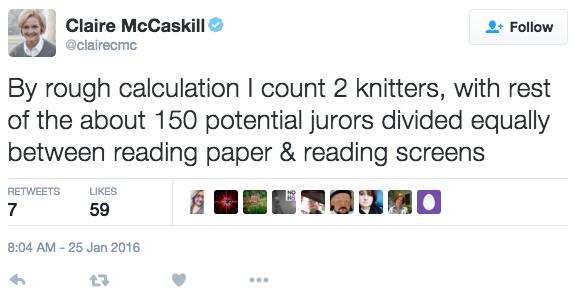
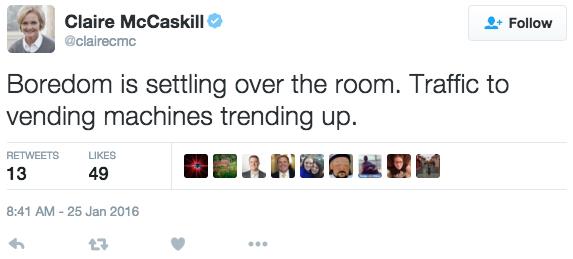
A recent Business Insider article covered U.S. Sen. Claire McCaskill’s live-tweeting of her jury duty experience:

Screen_Shot_2016-02-24_at_6.53.38_AMScreen_Shot_2016-02-24_at_6.54.17_AM
In addition to photos and amusing posts about her fellow jurors was the prediction that the trial attorneys would use preemptory strikes to get rid of her.

Instead, McCaskill (D-Mo.) was surprised to find she was selected to serve on a jury for a slip-and-fall case. (To her credit, she stopped her social media play-by-play once trial began, unlike some jurors we have encountered.)

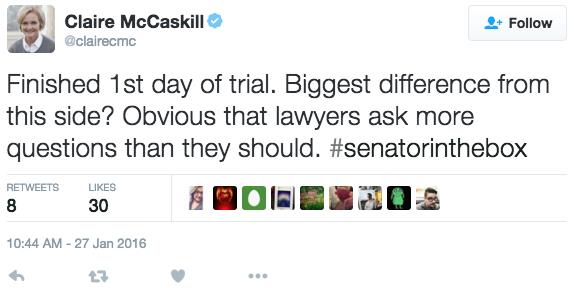
However, once trial was over and she resumed her social media documentation, she made what we thought was a poignant observation about the importance of respecting jurors’ time – no matter who they are.

She wrote,
Screen_Shot_2016-02-24_at_7.01.01_AM

When another Twitter user asked her to elaborate she responded,

Screen_Shot_2016-02-24_at_7.04.39_AM

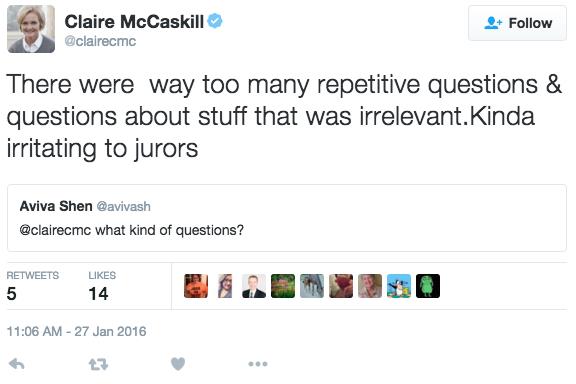
Now, Sen. McCaskill is an attorney and is quite familiar with the trial process, so it’s saying something that she perceived the questioning to be excessive and immaterial. Furthermore, that a member of Congress – a body that has perfected the art of wasting time – expressed a feeling of her time not being respected spoke volumes. So you can imagine what her fellow jurors, who don’t have courtroom experience and have likely only seen the rapid-fire questioning on TV dramas, were thinking.

Many of the trial teams we work with make it a point to tell jurors up front that their time is being respected and every effort will be made to maintain a healthy pace so they can get back to their busy lives. During post-trial interviews, we have observed this simple sentiment can go a long way.

The senator’s account of her jury duty experience also highlights the importance of acknowledging the prevalence of social media and how ingrained it is into many jurors’ lives. The widespread social media of modern life can help when doing pre-trial research on potential jurors, and monitoring jurors’ social media accounts during trial can alert the trial team when a juror is inappropriately discussing the case online.

Given this confirmation of what we have heard from jurors all over the country, perhaps the most surprising aspect of Sen. McCaskill’s experience is that she wasn’t chosen as foreperson.

To discuss how we might be able to help you tighten up your trial presentation, contact Senior Vice President Claire Luna at 714.754.1010 or cluna@juryimpact.net.

Beware the “Unbiased” Juror

Jury selection is an interesting process, because it can provide an opportunity to get to know your jurors a little bit, and read between the lines of their answers to determine whether their experiences and predispositions might make them helpful or harmful to your case.

It’s also fascinating to observe the lengths some jurors will go to get out of jury duty.  We could write a book about the amusing excuses we’ve heard through the years.  But in addition to the people trying desperately to get out of jury service, we have also encountered those who want more than anything to serve.  While it’s worth applauding these jurors’ strong sense of civic pride, it probably goes without saying that counsel should proceed with caution when it comes to jurors who seem too eager to sit on the jury.

In one case, an 18-year-old juror enthusiastically volunteered to miss three weeks of his senior year of high school to “fulfill my civic duty.”  The judge sternly told him to go back to school.  Although this teen’s motivations to serve on a jury were fairly innocent (the last semester of high school is a treat for no one), some jurors don’t have such pure intentions.

For example, we also recall the juror who professed her “open mind” regarding the defendant hospital despite “hearing some negative things,” and she repeatedly asserted her ability to give a fair shot to the defense.  She repeatedly denied having any knowledge or experience that would influence her verdict.

However, during a lunch break the juror got to chatting with the bailiff outside the courtroom, to whom she confided her ex-husband was currently embroiled in a major lawsuit against this very hospital regarding care their son received.  Fortunately, the bailiff brought this to the judge’s attention and the juror was stricken from the panel – after considerable protestation and insistence this ongoing lawsuit regarding her young child wouldn’t affect her ability to remain fair.  It struck us that perhaps her strong, vocal desire to get on this jury, and blatant omission of key information despite specific questioning, was out of a yearning to exact justice on the hospital.

The point is, nobody is unbiased.  Where you shop, the products you buy, where you get your news and how you vote all inform your viewpoints, and our personal choices and proclivities can say a lot about who we are.  Just ask Google and Facebook, which have successfully commoditized our personal habits.  So anyone who says they are an empty canvas, hold no opinions on current events, don’t make any snap judgments in their daily lives and can remain totally, absolutely unbiased and not form any opinions until the very end of closing arguments should be treated with a heavy dose of skepticism.

After all, if the morning of Election Day your neighbor said they still hadn’t formed any opinions about the candidates, had no leanings about who they would vote for and would decide in the voting booth, would you believe them?

Although there are many reasons to watch for jurors who seem too eager to get on your jury, we also understand judges don’t always allow a lot of time (or any) for voir dire.  In these cases, once we get a copy of the jury list our research team conducts full social media, public records and Internet audits of your potential jurors.  You would be amazed what people put out there on social media, and how much these postings, “likes” and message board opinions can help identify favorable and unfavorable jurors – regardless of what they say under direct questioning.

If you have a trial coming up and are curious about the motivations of those on your venire, contact Senior Vice President Claire Luna at 714.754.1010 or cluna@juryimpact.net to discuss how we can help.

Radical Similarities

As Bernie Sanders, Ted Cruz and Donald Trump lead popular uprisings from the far left and right, it becomes easy to frame the 2016 political season as a clash of extreme ideologies and a rejection of compromise. Their supporters can be easily cast as radicals – confident, righteous and unlikely to be influenced by new evidence or arguments. But while we watch how these extreme political beliefs play out in campaigns on Fox News and CNN, it’s worth asking how such extremism could cloud judgment in the jury box when new information is heard.

The Association for Psychological Science recently published research that suggests extreme political attitudes, such as those that can be revealed during voir dire, could also predict how some jurors will process the new information they hear. The study found political extremists are less likely to change their minds when provided new, conflicting information – even about nonpolitical issues. Researchers concluded extremists believed their beliefs were superior and were less likely to stray from those pre-existing beliefs.

For potential jurors with extreme attitudes, that could mean either hardheaded ideologues impervious to fresh evidence or confidently independent thinkers immune to groupthink. Either way, they should raise a red flag during voir dire.

“Importantly,” wrote Mark J. Brandt, psychological scientist and lead researcher of the study, “the results couldn’t be explained by participants’ level of education or their so-called need for ‘cognitive closure’” — the need for a definitive answer or an aversion to ambiguity. So while common sense has us gawking at the obvious contrasts of Left to Right, this new research shows how much radicals – extremists on either side – may actually think alike.

If you’re interested in discussing how we identify potential extremists in a venire, contact Senior Vice President Claire Luna at 714.754.1010 or cluna@juryimpact.net.

1 … 4 5 6 7 8 … 34